Asparagus is one of those ingredients which is extremely seasonal and all the better for that! Between April and June this tasty vegetable is in season in the UK and needs using often before it ends.
This simple recipe utilises local Asparagus and also a local Abergavenny Goats Cheese though most areas will have their own variants and should be used appropriately.
Teamed with a Slaw and a Cucumber Pickle the tart can be eaten hot or cold and makes a light lunch or tasty supper, or a dish in a picnic.
Asparagus and Goats Cheese Tart
Ingredients
1 pack readymade Puff Pastry or even better make your own
6-8 Asparagus spears
4 Ripe Tomatoes
125 grams Goat Cheese
A little Parmesan
Salt and Pepper to taste
Egg Wash.
Roll 2/3 of the Pastry until it fits a baking tray.
Score a line ½ inch inside the pastry to create a border which will puff up. Put in fridge to chill.
Snap the Asparagus at its natural braking point, cut in half lengthways and put into chilled water.
Slice the tomatoes around the equator and season with salt and pepper – set aside.
Cut the Goats Cheese into rounds you can usually get 6-8 rounds.
Remove the pastry from the fridge and egg wash the border only.
Layer the tomatoes, asparagus and goats cheese inside the border.
Season again and grate Parmesan over the tart.
Bake in an oven at 200c for 20-25 minutes till the border is risen and golden.
Cool and then chill.
Serve with a green salad heavy on the Rocket or Watercress, Coleslaw and Cucumber Pickle.
Coleslaw
Shred Cabbage leaves, grate Carrot and thinly slice an Onion. I have not given exact quantities as everyone has their own preferred balance. Season well and mix together with Mayonnaise. Taste and season again if needed. Chill in fridge until required. (Grated Apple makes a refreshing addition and a little Lime Juice adds a piquancy).
Cucumber Relish
A great standby that can be served with a whole range of meats and fish or can be added to a sandwich for an amazing lift.
I Cucumber (weighing about 1lb)
1 Small onion
2 ½ oz. sugar
1 dessertspoon of salt
Chopped Mint or Dill
¼ pint Cider or White Wine Vinegar
Freshly ground Black Pepper
Slice the Cucumber very thinly – a mandolin makes his easy
Slice the Onion to the same thickness.
Combine in a bowl and add the Salt and Sugar. Sprinkle in the Dill or Mint then add the Pepper and finally the vinegar.
Chill in the fridge for at least 3 hours.
This pickle lasts up to 2 weeks – if you can keep your hands off – and the flavour develops all the time.
Thge season is running out!! Enjoy Asparagus whilst you can.
Total Pageviews
Saturday, 11 June 2011
Wednesday, 4 May 2011
A day with Berthinet
What an opportunity, a whole day with Richard Berthinet, learning to bake his way.
The School, tucked away down a side street in Bath is welcoming and as you walk through the door promises an experience. It just looks dedicated to really good bread, and a subtle smell of fresh yeast and baking permeates the atmosphere.
Over coffee and toast – home- made Sourdough naturally, you get to know the other students (12 in our case), before donning aprons and meeting the man himself.
Full of Gallic charm and with a great sense of humour Richard Berthinet sets the tone for the day in his introduction. A discussion on bread from supermarkets – or bread related products as he prefers to call it – makes you realise that bread from commercial bakeries is not bread as we know it. Comparing the smell of a commercial sliced pan to a wash cloth used to clean down after a busy day he then crushes the slice into a compact ball and explains that is what happens in your stomach.
No wonder a sandwich can make you feel positively bloated.
Four ingredients are needed to make good bread, flour, water, salt and yeast. Then reading the ingredients from a commercial loaf he lists the 10 15 additional elements and asks why? Purely to make the bread consistent and quickly. But, at what cost?
Today we will be using just the four and allowing the bread to prove and rise, each stage taking as long as a commercial loaf does from initial mix to sliced, packaged product.
Instead of wooly, pap we will be making breads which require chewing and allow the acids in saliva to start the breakdown of the crust and crumb making it much more digestible than the suck and swallow commercial sliced.
Then it’s on to the actual making. Combining the four basic ingredients to a sloppy sticky dough – “a bit like porridge” he tells us – we pour the mix onto the work surface. There is no flour on which to place the dough – baking books which advocate a well-floured surface and which advocate adding more flour if the dough is sticky are fundamentally changing the recipe we are told.
The bread is not kneaded either.
This beats all of the air out of the dough when we should be trying to get it in.
Instead the dough is lifted, one end slapped down on the bench, and folded over and stretched. Use of a plastic scraper to ensure a ball of dough forms is required on a regular basis – every four stretches – and amazingly a smooth silky dough begins to develop within minutes.
Proved for an hour the dough is poured back onto the surface – this time with a literal pinch of flour on which to rest it. There is no knocking back!!! Again the logic is why punch all of the air and gasses that have developed during fermentation out?
The dough is taken for a walk around the work-surface with the scraper to ensure the smoothness before being worked in to the final shape. Very careful cutting and moulding – “building the spine of the bread” produces the final article which is then risen again before baking.
This produces a bread with a good crust and smooth crumb with real taste and texture.
The first bread we made was Fougasse, an interesting bread which looks like the leaf of a Swiss Cheese plant, with patters produced by cutting lines with the ubiquitous scraper. Even though we all followed the same basic pattern each Fougasse was unique. Different angles for the slashes, lengths of cut and degrees of separation of the sides produced different results. The result was a collection of artisan breads – or as Scott one of the chefs at Ballymaloe House once said “ Artisan, another word for inconsistent” Inconsistency of shape aside what came out of the oven was a crusty chewy delight, which Richard then used as the centrepiece of his basket of breads for the table.
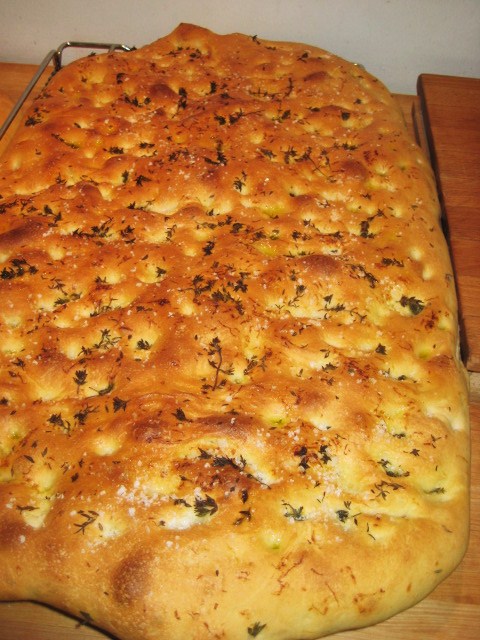
We also made an olive oil dough converted to focaccia, with two toppings and some baguettes as well as standard loaves, trimmings were made into breadsticks with olive or cheese fillings.
Richard converted one dough to a a large, pizza like square, covered with onions, cheese and herbs with an egg and cream mix which then got baked off.
Finally we sat down for lunch, our breads, some soup, a selection of meats, rillettes, olives, a glass of wine, cheeses and coffee.
What a great day, so much learning, hands on practice, personal attention from Richard and his two teachers and good companions in the kitchen. Go there if you have an interest in bread, the only danger is as Richard put it “You will turn into a bread bore!”
The School, tucked away down a side street in Bath is welcoming and as you walk through the door promises an experience. It just looks dedicated to really good bread, and a subtle smell of fresh yeast and baking permeates the atmosphere.
Over coffee and toast – home- made Sourdough naturally, you get to know the other students (12 in our case), before donning aprons and meeting the man himself.
Full of Gallic charm and with a great sense of humour Richard Berthinet sets the tone for the day in his introduction. A discussion on bread from supermarkets – or bread related products as he prefers to call it – makes you realise that bread from commercial bakeries is not bread as we know it. Comparing the smell of a commercial sliced pan to a wash cloth used to clean down after a busy day he then crushes the slice into a compact ball and explains that is what happens in your stomach.
No wonder a sandwich can make you feel positively bloated.
Four ingredients are needed to make good bread, flour, water, salt and yeast. Then reading the ingredients from a commercial loaf he lists the 10 15 additional elements and asks why? Purely to make the bread consistent and quickly. But, at what cost?
Today we will be using just the four and allowing the bread to prove and rise, each stage taking as long as a commercial loaf does from initial mix to sliced, packaged product.
Instead of wooly, pap we will be making breads which require chewing and allow the acids in saliva to start the breakdown of the crust and crumb making it much more digestible than the suck and swallow commercial sliced.
Then it’s on to the actual making. Combining the four basic ingredients to a sloppy sticky dough – “a bit like porridge” he tells us – we pour the mix onto the work surface. There is no flour on which to place the dough – baking books which advocate a well-floured surface and which advocate adding more flour if the dough is sticky are fundamentally changing the recipe we are told.
The bread is not kneaded either.
This beats all of the air out of the dough when we should be trying to get it in.
Instead the dough is lifted, one end slapped down on the bench, and folded over and stretched. Use of a plastic scraper to ensure a ball of dough forms is required on a regular basis – every four stretches – and amazingly a smooth silky dough begins to develop within minutes.
Proved for an hour the dough is poured back onto the surface – this time with a literal pinch of flour on which to rest it. There is no knocking back!!! Again the logic is why punch all of the air and gasses that have developed during fermentation out?
The dough is taken for a walk around the work-surface with the scraper to ensure the smoothness before being worked in to the final shape. Very careful cutting and moulding – “building the spine of the bread” produces the final article which is then risen again before baking.
This produces a bread with a good crust and smooth crumb with real taste and texture.
The first bread we made was Fougasse, an interesting bread which looks like the leaf of a Swiss Cheese plant, with patters produced by cutting lines with the ubiquitous scraper. Even though we all followed the same basic pattern each Fougasse was unique. Different angles for the slashes, lengths of cut and degrees of separation of the sides produced different results. The result was a collection of artisan breads – or as Scott one of the chefs at Ballymaloe House once said “ Artisan, another word for inconsistent” Inconsistency of shape aside what came out of the oven was a crusty chewy delight, which Richard then used as the centrepiece of his basket of breads for the table.
We also made an olive oil dough converted to focaccia, with two toppings and some baguettes as well as standard loaves, trimmings were made into breadsticks with olive or cheese fillings.
Richard converted one dough to a a large, pizza like square, covered with onions, cheese and herbs with an egg and cream mix which then got baked off.
Finally we sat down for lunch, our breads, some soup, a selection of meats, rillettes, olives, a glass of wine, cheeses and coffee.
What a great day, so much learning, hands on practice, personal attention from Richard and his two teachers and good companions in the kitchen. Go there if you have an interest in bread, the only danger is as Richard put it “You will turn into a bread bore!”
Tuesday, 19 April 2011
Bad times in Spain
The down side of Spain is the huge British influence. OK so Alicante and Benidorm are famed for their all day English Breakfasts and Watney’s Red Barrel but the Brit influence is far more insidious than that.
Great local markets exist supplying fresh and local ingredients. To cook daily with only the freshest is a dream, but that is not the aim of most ex-pats.
Brilliant local breads are available from small bakeries in every part but in Alicante province Iceland seems to be the supermercado of choice for the British population.
OK I can see that some essential icons are not available – Marmite seems to be a perpetual request from my Spanish based relatives but to walk into a shop and be confronted by freezers full of Mothers Pride and Aunt Bessie’s frozen products is just plain depressing.
If Spain is the aim embrace it, don’t just convert it to a sunnier Southend.
In the small town where my brother-in-law has settled there exists a corner shop – wittily called “The Corner Shop” which supplies all your British needs from papers to Instant Whip. Just around the corner is Cornish Pride purveyors of pasties to the retired.
On the recommendation of a 14 year old I tried their legendary Chicken Tikka turnovers and was immediately transported back home. It was that unique taste of Chip Shop Curry Sauce that provided the flavour though I have to say that the pastry was very good.
There again just a short walk away a baker was producing breads and pastries to die for.
Why go to another country and import your food from home?
And eating out was similar.
We had a superb meal locally, great taps to start, a wide choice of first courses, a range of regional dishes and desserts that were really good _ even the dreaded Flan – a Spanish staple- was fresh and tasty. Coffee and a liqueur finished the meal which, with wine thrown in cost a mere €22 per head.
There again we visited one of the worst restaurants I have ever eaten in.
It’s really good said the BIL, and the menu downloaded from the web bore this out. A wide range of dishes all of which looked delicious and a Welsh Chef using local produce to the full on an interesting a la carte menu. We piled into the car and set of for the 40 minute drive.
On arrival all looked well, a courtyard with tables or indoor eating. A chilly evening meant that indoors was best.
A 10 minute wait in an empty restaurant did not bode well and when the server eventually asked “Menu or Carvery?” my heart sank. Menu please was the request. It arrived bearing little resemblance to the one on the website.
“Oh, Chef has left” seemed to explain the changes, “but my wife has been cooking this for about a year so she’s well practiced.”
So to the meal. I ordered a starter of Crab Tuna and Prawn in a thousand Island dressing. What arrived was a travesty. Though the local fish market had all there fishy ingredients in abundance what I got was tinned Tuna, prawns that probably came from Iceland’s bargain range and worst of all Crab Sticks that had never borne any relationship to our cancerian friends, and an appalling cheap seafood sauce with Kiwi Fruit, Orange Segment and Strawberry garnish Utterly inedible though the detritus did not even rate a question from the server.
The main course was equally disappointing, a steak done to the consistency of a well- used army boot, greasy chips and a limp salad. Our party was not impressed and neither were a couple who ate there regularly under the previous chef.
To top things a table of 14 Brits were celebrating a birthday with the Carvery and the volume of their celebration was increased by the introduction of two wandering musicians who seemed under the impression that they were a Mariachi band whilst pumping out Brit Hits such as Guantamamera and Una Paloma Blanca.
The regular couple told the proprietor that they would have dessert in the bar as it was more peaceful and told me that they had been coming long enough to tell him exactly what they thought of the food and the experience.
It turned out that a local Carvery had opened and the owners were rushing to counter its success by introducing their own, cutting down on the menu and the quality of the ingredients used. The race to the bottom was more likely to be a race into bankruptcy than the salvation of the business.
Dessert was quite good though totally un-memorable.
The BIL was mortified by the experience and vowed never to return. I don’t think that he will have to, judging by our experience and the fact that, apart from the birthday crowd and our party of 5, there were 2 diners suggests that the restaurant will not be operating by now – hence my not naming it.
Good food gone bad, local dishes replaced by euro-pap and an attempt to bring the Harvester to Valencia – needless to say the owners were Brits.
One good introduction from these islands was found unexpectedly in the small mountain town of Mura. Turning a corner in the perpetual search for Café Solo I came upon a branch of Supervalu!!!
This should be good I told the BIL, in Ireland they champion local produce and high quality. And they did. Local meats and cheeses, fresh bread, great local vegetables and fish so fresh that it made even the fish market look stale and tired. Add to this a brilliant array of wines again many very local and you had a pleasure to behold.
Compare Supervalu to Iceland and there is no contest. Supervalu did what it does in Ireland, concentrate on good, seasonal and local produce, Iceland does what it does in the UK knock out frozen generic brands.
Sadly the majority of Brits who move to Spain only want the weather and do not want to embrace the culture or the foods, and want to live in the seventies as well.
Great local markets exist supplying fresh and local ingredients. To cook daily with only the freshest is a dream, but that is not the aim of most ex-pats.
Brilliant local breads are available from small bakeries in every part but in Alicante province Iceland seems to be the supermercado of choice for the British population.
OK I can see that some essential icons are not available – Marmite seems to be a perpetual request from my Spanish based relatives but to walk into a shop and be confronted by freezers full of Mothers Pride and Aunt Bessie’s frozen products is just plain depressing.
If Spain is the aim embrace it, don’t just convert it to a sunnier Southend.
In the small town where my brother-in-law has settled there exists a corner shop – wittily called “The Corner Shop” which supplies all your British needs from papers to Instant Whip. Just around the corner is Cornish Pride purveyors of pasties to the retired.
On the recommendation of a 14 year old I tried their legendary Chicken Tikka turnovers and was immediately transported back home. It was that unique taste of Chip Shop Curry Sauce that provided the flavour though I have to say that the pastry was very good.
There again just a short walk away a baker was producing breads and pastries to die for.
Why go to another country and import your food from home?
And eating out was similar.
We had a superb meal locally, great taps to start, a wide choice of first courses, a range of regional dishes and desserts that were really good _ even the dreaded Flan – a Spanish staple- was fresh and tasty. Coffee and a liqueur finished the meal which, with wine thrown in cost a mere €22 per head.
There again we visited one of the worst restaurants I have ever eaten in.
It’s really good said the BIL, and the menu downloaded from the web bore this out. A wide range of dishes all of which looked delicious and a Welsh Chef using local produce to the full on an interesting a la carte menu. We piled into the car and set of for the 40 minute drive.
On arrival all looked well, a courtyard with tables or indoor eating. A chilly evening meant that indoors was best.
A 10 minute wait in an empty restaurant did not bode well and when the server eventually asked “Menu or Carvery?” my heart sank. Menu please was the request. It arrived bearing little resemblance to the one on the website.
“Oh, Chef has left” seemed to explain the changes, “but my wife has been cooking this for about a year so she’s well practiced.”
So to the meal. I ordered a starter of Crab Tuna and Prawn in a thousand Island dressing. What arrived was a travesty. Though the local fish market had all there fishy ingredients in abundance what I got was tinned Tuna, prawns that probably came from Iceland’s bargain range and worst of all Crab Sticks that had never borne any relationship to our cancerian friends, and an appalling cheap seafood sauce with Kiwi Fruit, Orange Segment and Strawberry garnish Utterly inedible though the detritus did not even rate a question from the server.
The main course was equally disappointing, a steak done to the consistency of a well- used army boot, greasy chips and a limp salad. Our party was not impressed and neither were a couple who ate there regularly under the previous chef.
To top things a table of 14 Brits were celebrating a birthday with the Carvery and the volume of their celebration was increased by the introduction of two wandering musicians who seemed under the impression that they were a Mariachi band whilst pumping out Brit Hits such as Guantamamera and Una Paloma Blanca.
The regular couple told the proprietor that they would have dessert in the bar as it was more peaceful and told me that they had been coming long enough to tell him exactly what they thought of the food and the experience.
It turned out that a local Carvery had opened and the owners were rushing to counter its success by introducing their own, cutting down on the menu and the quality of the ingredients used. The race to the bottom was more likely to be a race into bankruptcy than the salvation of the business.
Dessert was quite good though totally un-memorable.
The BIL was mortified by the experience and vowed never to return. I don’t think that he will have to, judging by our experience and the fact that, apart from the birthday crowd and our party of 5, there were 2 diners suggests that the restaurant will not be operating by now – hence my not naming it.
Good food gone bad, local dishes replaced by euro-pap and an attempt to bring the Harvester to Valencia – needless to say the owners were Brits.
One good introduction from these islands was found unexpectedly in the small mountain town of Mura. Turning a corner in the perpetual search for Café Solo I came upon a branch of Supervalu!!!
This should be good I told the BIL, in Ireland they champion local produce and high quality. And they did. Local meats and cheeses, fresh bread, great local vegetables and fish so fresh that it made even the fish market look stale and tired. Add to this a brilliant array of wines again many very local and you had a pleasure to behold.
Compare Supervalu to Iceland and there is no contest. Supervalu did what it does in Ireland, concentrate on good, seasonal and local produce, Iceland does what it does in the UK knock out frozen generic brands.
Sadly the majority of Brits who move to Spain only want the weather and do not want to embrace the culture or the foods, and want to live in the seventies as well.
Monday, 18 April 2011
Signs Of Spring - Fresh and tasty
April means the return of two of my favourite foods, Asparagus and Rhubarb.
The delicate green spears of Asparagus are a real treat and made more so by their short season. There is something very wrong about buying Asparagus in November, not just the huge number of food miles and CO2 expended to fly them in from Peru or Chile, but the flavour is coarser, less fragrant and subtle.
It is the short season, about six weeks that adds to the luxury of the experience, fresh Asparagus is more than an ingredient, it is an experience and a sure sign that summer is around the corner. Use them in season and use them often.
Asparagus Tips with a Hollandaise is a dish in its own right or an amazing accompaniment to a well-cooked rare rib of Beef or roast Cod. Asparagus Soup is a classic, light fresh and packed with flavour.
On a visit to my parents’ house near Canterbury I passed a sign in a field, “Our Asparagus available now”.
A short detour out onto the marshes at Seasalter led us past the Michelin Starred ‘Jolly Sportsman’ and on to Mallards Farm. The Asparagus had just been cut and was still being bagged when we arrived. Half a Kilo was rapidly aged to the shopping bag and my daydreams turned to dishes containing the delicate vegetable.
On arrival chez parents I spotted a well -developed Rhubarb patch. Three or four crowns were pushing their pink stems skywards and crying out for cutting. As I have not had Rhubarb this year a request for some was made almost before exchanging ritual greetings with the ancestors. Fortunately they agreed.
With both the Asparagus and Rhubarb as fresh as could be a method of getting it home in pristine condition became the priority, Canterbury to Cwmbran is 4 hours in anyone’s money and very dependent on the state of the M25. Added to this was a diversion to Hove for a visit to my daughter and grandchildren so the fresh produce could be as dehydrated as Peruvian produce unless I was careful.
A cunning system of damp kitchen roll, recycled plastic bags and a cool bag ensured the right ambient conditions for the journey and I am pleased to report that both ingredients arrived home safely.
What about the food miles I hear you cry. Well, to my mind there were none. I was visiting Canterbury in any event and thus the miles were being undertaken anyway, the produce was not sent to me but returned on a journey which was intended and not unique to the food.
Back home I converted the produce to Asparagus Soup and Rhubarb and Ginger Crumble, two dishes which bring out the real flavours of the main ingredients.
Asparagus Soup
500 grams of fresh Asparagus.
1 Shallot
500 mils Chicken Stock
Freshly ground Black Pepper
25 grams Butter
Chives to garnish.
Snap the Asparagus (it will break naturally where the soft stalk meets the woodier base) and wash well.
Dice the Shallot and sweat gently in butter. Add the woodier stems cut to ½ inch pieces and continue to sweat for 10 minutes or so. Add the Chicken Stock and bring to the simmer for around another 10 minutes.
Strain and reserve the liquid discarding the stalks.
In a separate pan seat the Asparagus tips, again cut to ½ inch dice. Add a good pinch of the Pepper. After 10 minutes add the reserved Stock and bring back to the boil, simmering for 5 minutes. Liquidise and add a little water if you like your soup on the thin side. Bring back to a near simmer and serve garnished with a few snipped chives.
200 mils of Cream may be added to give a light but creamy soup.
Rhubarb and Ginger Crumble
For the Rhubarb
700 grams Rhubarb
50 grams Stem Ginger
75 grams Sugar
For the topping
110 grams Plain Flour
110 grams Butter
50 grams Granulated Sugar
Wash the Rhubarb and cut into 1 inch dice.
Place in a pan with the Sugar and bring gently to the boil. DO NOT add any water as Rhubarb is full of liquid and a flood will ensue!! Simmer for around 10 minutes or until about half cooked. Cool slightly then add the Stem Ginger in small dice or thin strips.
Meanwhile rub the Butter into the Flour till it looks like large Breadcrumbs and then mix in the sugar.
Transfer the Rhubarb and Ginger to an ovenproof dish and scatter the topping over.
Bake in an oven for 20 minutes or until the topping is crispy and golden brown.
Serve with Crème Anglaise, Whipped Cream and Brown Sugar or Ice Cream.
The delicate green spears of Asparagus are a real treat and made more so by their short season. There is something very wrong about buying Asparagus in November, not just the huge number of food miles and CO2 expended to fly them in from Peru or Chile, but the flavour is coarser, less fragrant and subtle.
It is the short season, about six weeks that adds to the luxury of the experience, fresh Asparagus is more than an ingredient, it is an experience and a sure sign that summer is around the corner. Use them in season and use them often.
Asparagus Tips with a Hollandaise is a dish in its own right or an amazing accompaniment to a well-cooked rare rib of Beef or roast Cod. Asparagus Soup is a classic, light fresh and packed with flavour.
On a visit to my parents’ house near Canterbury I passed a sign in a field, “Our Asparagus available now”.
A short detour out onto the marshes at Seasalter led us past the Michelin Starred ‘Jolly Sportsman’ and on to Mallards Farm. The Asparagus had just been cut and was still being bagged when we arrived. Half a Kilo was rapidly aged to the shopping bag and my daydreams turned to dishes containing the delicate vegetable.
On arrival chez parents I spotted a well -developed Rhubarb patch. Three or four crowns were pushing their pink stems skywards and crying out for cutting. As I have not had Rhubarb this year a request for some was made almost before exchanging ritual greetings with the ancestors. Fortunately they agreed.
With both the Asparagus and Rhubarb as fresh as could be a method of getting it home in pristine condition became the priority, Canterbury to Cwmbran is 4 hours in anyone’s money and very dependent on the state of the M25. Added to this was a diversion to Hove for a visit to my daughter and grandchildren so the fresh produce could be as dehydrated as Peruvian produce unless I was careful.
A cunning system of damp kitchen roll, recycled plastic bags and a cool bag ensured the right ambient conditions for the journey and I am pleased to report that both ingredients arrived home safely.
What about the food miles I hear you cry. Well, to my mind there were none. I was visiting Canterbury in any event and thus the miles were being undertaken anyway, the produce was not sent to me but returned on a journey which was intended and not unique to the food.
Back home I converted the produce to Asparagus Soup and Rhubarb and Ginger Crumble, two dishes which bring out the real flavours of the main ingredients.
Asparagus Soup
500 grams of fresh Asparagus.
1 Shallot
500 mils Chicken Stock
Freshly ground Black Pepper
25 grams Butter
Chives to garnish.
Snap the Asparagus (it will break naturally where the soft stalk meets the woodier base) and wash well.
Dice the Shallot and sweat gently in butter. Add the woodier stems cut to ½ inch pieces and continue to sweat for 10 minutes or so. Add the Chicken Stock and bring to the simmer for around another 10 minutes.
Strain and reserve the liquid discarding the stalks.
In a separate pan seat the Asparagus tips, again cut to ½ inch dice. Add a good pinch of the Pepper. After 10 minutes add the reserved Stock and bring back to the boil, simmering for 5 minutes. Liquidise and add a little water if you like your soup on the thin side. Bring back to a near simmer and serve garnished with a few snipped chives.
200 mils of Cream may be added to give a light but creamy soup.
Rhubarb and Ginger Crumble
For the Rhubarb
700 grams Rhubarb
50 grams Stem Ginger
75 grams Sugar
For the topping
110 grams Plain Flour
110 grams Butter
50 grams Granulated Sugar
Wash the Rhubarb and cut into 1 inch dice.
Place in a pan with the Sugar and bring gently to the boil. DO NOT add any water as Rhubarb is full of liquid and a flood will ensue!! Simmer for around 10 minutes or until about half cooked. Cool slightly then add the Stem Ginger in small dice or thin strips.
Meanwhile rub the Butter into the Flour till it looks like large Breadcrumbs and then mix in the sugar.
Transfer the Rhubarb and Ginger to an ovenproof dish and scatter the topping over.
Bake in an oven for 20 minutes or until the topping is crispy and golden brown.
Serve with Crème Anglaise, Whipped Cream and Brown Sugar or Ice Cream.
Two good dishes that show off the real flavours of Spring and indicate that A Summer of really fresh fruit and vegetables is just around the corner.
Wednesday, 6 April 2011
Spain, the good, the bad and the unutterable
Just got back from a week in Spain, a small village called Orba in Valencia.
Spain has a weird bi-polar food culture, influenced hugely by the influx of foreigners with the British and Germans having a huge influence.
On the one hand there are brilliant local ingredients, fish and fruit, vegetables and breads on the other an invasion even more insidious than the ubiquitous golden arches and fried chicken establishments.
But to start with the good. Even in March there is a wealth of really fresh local food. Oranges, Lemons and Grapefruit abound so freshly squeezed juice every morning and Homemade Lemonade to wash down those interesting afternoon lunches.
Local products are freely available and at their ripest and freshest in the local markets. Pedreguer Market on a Sunday is buzzing. Yes there are lots of clothes stalls but the highlight, and the first that you come to are dedicated to food. The freshest of herbs and a wide range of salad leaves, Aubergines in many shapes and colours, onions ranging from big juicy sweet Spanish to pungent garlic flavoured Spring onions and several varieties of garlic itself. Inevitably a huge stock of Oranges was on display though the scrumping activities of the local clan meant that they were not on the shopping list.
The real stars of the show, though, were the Tomatoes. Several varieties were on offer, traditional round reds, Beef, Plum, Cherry and some really interesting multi coloured ones. Inspired by this bounty I rapidly devised several days meals and with an investment of around €5 I took several kilos back to the house.
Chopped Spring Onion – the garlicky one was sweated down with chopped local celery in a little Olive Oil whilst around 3 kilos of tomatoes were quartered and added to the pan. Simmered gently for a round 40 minutes and then seasoned and liquidised they surrendered a couple of litres of tomato sauce.
The first outing for the sauce was as an accompaniment to Pasta. An onion was diced and sweated before diced Chorizo, again from the market, joined in. Fresh tomato sauce was added and finally the cooked Pasta before serving with a fresh green salad and a tomato salad of six varieties with a little seasoning and a drizzle of Olive Oil.
The following day the sauce was resurrected as the basis for Ratatouille with purple and pink-striped Aubergines and some Courgettes, Onions and Celery. To provide the carbohydrates I taught Arran my 14 year old step-nephew to make bread and we served fresh rolls as an accompaniment.
Bread surfaced again the next day along with the tomato sauce. Rolls were made and, once risen, were rolled out really thin to make a Pizza base. The sauce provided the topping and individuals added their own choice of Mushrooms, Onions, Tomatoes, Herbs, Seasoning, Cheeses (either local or generically Spanish) and meats for 5 totally different Pizzas, again served with a (largely) Rocket salad and wine from the Jalon Valley.
Amazingly we were in the only area of Spain to have rain – though snow fell on some of the higher ground- so it was as well that Denia had an indoor market to continue the foodie adventure.
Valenciana produce was again well to the fore but some stalls offered Galician and Catalan alternatives. But before we could shop there was the matter of breakfast.
Café Solo may not be Espresso but it runs it a damn close second and accompanied by a fresh Bocadillo and a few Churros (open sandwich and deep fried choux pastry dredged in icing sugar) we were ready.
The influx of people from across Europe was highlighted in the market. A German butcher, a Dutch patisserie, and another German, this time baking, all had stalls. The local butchers specialised in Rabbit alongside the Beef, Pork, Lamb and Chicken and a huge range of charcuterie was available.
Fruit stalls, more exotic than at Pedreguer, but still fresh and cheap, jostled for space with the bread and meats and at the rear were three fishmongers. I have to say that I despair at the Spanish approach to fishing. Along with the shrimp, crab and prawns were beautiful John Dory, Monkfish and Sea Bream but they were all tiny. I thought that the EU protected fish stocks but here they were ripped forth before their time, unformed. I wrestled with my conscience as the fish looked wonderful and just ready for a really good stew or soup – and I still had some tomato sauce – but in the end I left them.
The only baby fish that I consumed came later in the day. Tapas for lunch saw us settled in a restaurant surely modelled on Yo! Sushi. You selected from a range and the bill was based on the number and size of the cocktail sticks used to hold the tasty morsels together. Amongst others I had a fresh Ham and Pepper Bruschetta (there must be a Spanish word) with a chilled poached Quail Egg and an amazing dish with elvers on top. Elvers are a real luxury, and living just a few miles from the Severn one that I should have tried earlier – if only they were not all exported to Spain!!
From there it all went downhill but that will be a separate rant.
Spain has a weird bi-polar food culture, influenced hugely by the influx of foreigners with the British and Germans having a huge influence.
On the one hand there are brilliant local ingredients, fish and fruit, vegetables and breads on the other an invasion even more insidious than the ubiquitous golden arches and fried chicken establishments.
But to start with the good. Even in March there is a wealth of really fresh local food. Oranges, Lemons and Grapefruit abound so freshly squeezed juice every morning and Homemade Lemonade to wash down those interesting afternoon lunches.
Local products are freely available and at their ripest and freshest in the local markets. Pedreguer Market on a Sunday is buzzing. Yes there are lots of clothes stalls but the highlight, and the first that you come to are dedicated to food. The freshest of herbs and a wide range of salad leaves, Aubergines in many shapes and colours, onions ranging from big juicy sweet Spanish to pungent garlic flavoured Spring onions and several varieties of garlic itself. Inevitably a huge stock of Oranges was on display though the scrumping activities of the local clan meant that they were not on the shopping list.
The real stars of the show, though, were the Tomatoes. Several varieties were on offer, traditional round reds, Beef, Plum, Cherry and some really interesting multi coloured ones. Inspired by this bounty I rapidly devised several days meals and with an investment of around €5 I took several kilos back to the house.
Chopped Spring Onion – the garlicky one was sweated down with chopped local celery in a little Olive Oil whilst around 3 kilos of tomatoes were quartered and added to the pan. Simmered gently for a round 40 minutes and then seasoned and liquidised they surrendered a couple of litres of tomato sauce.
The first outing for the sauce was as an accompaniment to Pasta. An onion was diced and sweated before diced Chorizo, again from the market, joined in. Fresh tomato sauce was added and finally the cooked Pasta before serving with a fresh green salad and a tomato salad of six varieties with a little seasoning and a drizzle of Olive Oil.
The following day the sauce was resurrected as the basis for Ratatouille with purple and pink-striped Aubergines and some Courgettes, Onions and Celery. To provide the carbohydrates I taught Arran my 14 year old step-nephew to make bread and we served fresh rolls as an accompaniment.
Bread surfaced again the next day along with the tomato sauce. Rolls were made and, once risen, were rolled out really thin to make a Pizza base. The sauce provided the topping and individuals added their own choice of Mushrooms, Onions, Tomatoes, Herbs, Seasoning, Cheeses (either local or generically Spanish) and meats for 5 totally different Pizzas, again served with a (largely) Rocket salad and wine from the Jalon Valley.
Amazingly we were in the only area of Spain to have rain – though snow fell on some of the higher ground- so it was as well that Denia had an indoor market to continue the foodie adventure.
Valenciana produce was again well to the fore but some stalls offered Galician and Catalan alternatives. But before we could shop there was the matter of breakfast.
Café Solo may not be Espresso but it runs it a damn close second and accompanied by a fresh Bocadillo and a few Churros (open sandwich and deep fried choux pastry dredged in icing sugar) we were ready.
The influx of people from across Europe was highlighted in the market. A German butcher, a Dutch patisserie, and another German, this time baking, all had stalls. The local butchers specialised in Rabbit alongside the Beef, Pork, Lamb and Chicken and a huge range of charcuterie was available.
Fruit stalls, more exotic than at Pedreguer, but still fresh and cheap, jostled for space with the bread and meats and at the rear were three fishmongers. I have to say that I despair at the Spanish approach to fishing. Along with the shrimp, crab and prawns were beautiful John Dory, Monkfish and Sea Bream but they were all tiny. I thought that the EU protected fish stocks but here they were ripped forth before their time, unformed. I wrestled with my conscience as the fish looked wonderful and just ready for a really good stew or soup – and I still had some tomato sauce – but in the end I left them.
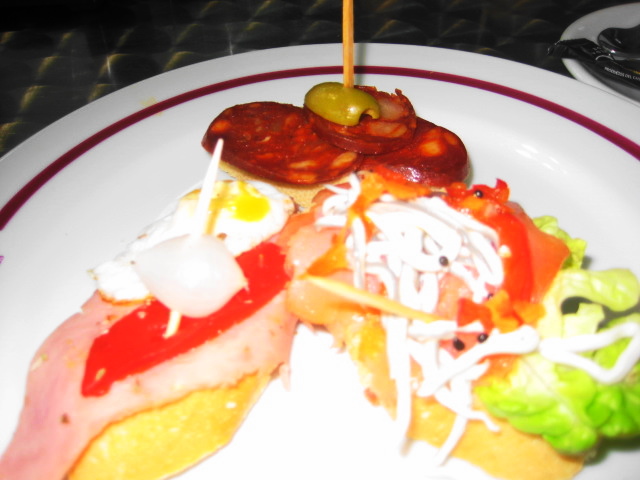
The only baby fish that I consumed came later in the day. Tapas for lunch saw us settled in a restaurant surely modelled on Yo! Sushi. You selected from a range and the bill was based on the number and size of the cocktail sticks used to hold the tasty morsels together. Amongst others I had a fresh Ham and Pepper Bruschetta (there must be a Spanish word) with a chilled poached Quail Egg and an amazing dish with elvers on top. Elvers are a real luxury, and living just a few miles from the Severn one that I should have tried earlier – if only they were not all exported to Spain!!
From there it all went downhill but that will be a separate rant.
Friday, 11 March 2011
Update to Bread post
After posting about the argument over additives in bread, and their possible effect on the rise in Gluten intolerance and Coeliac Disease, I was pleased to recieve Richard Bertinet's latest newsletter from which I have taken this article in its entirety:
"Possible breakthrough for Coeliacs
According to a new study in Italy, reported in the British Baker yesterday, slow-fermented bakery goods, such as sourdough bread, could be safe for coeliacs to eat. The study, by the University of Naples and the University of Bari, Italy, looked at whether the processing of wheat used for bakery products reduced gluten percentage, and found that fermentation significantly decreased the amount of native gluten present.
Thirteen patients with coeliac disease were divided into three groups. The first group were required to eat 200g per day of natural flour baked goods, the second were given baked food made from partially hydrolyzed wheat flour, while the third received baked food from fully hydrolyzed wheat flour.
The study found that a 60-day diet of baked goods made from hydrolyzed wheat flour, made with sourdough lactobacilli and fungal proteases, was not toxic to patients with coeliac disease.
Two patients from the first group had to abandon the study after developing clinical symptoms. Patients from the second group had no clinical complaints but a biopsy examination showed that their intestinal lining had changed. However, the third group had no clinical complaints, their blood levels of markers of immune reaction and their biopsies showed no changes to the intestinal lining."
Interesting reading!
"Possible breakthrough for Coeliacs
According to a new study in Italy, reported in the British Baker yesterday, slow-fermented bakery goods, such as sourdough bread, could be safe for coeliacs to eat. The study, by the University of Naples and the University of Bari, Italy, looked at whether the processing of wheat used for bakery products reduced gluten percentage, and found that fermentation significantly decreased the amount of native gluten present.
Thirteen patients with coeliac disease were divided into three groups. The first group were required to eat 200g per day of natural flour baked goods, the second were given baked food made from partially hydrolyzed wheat flour, while the third received baked food from fully hydrolyzed wheat flour.
The study found that a 60-day diet of baked goods made from hydrolyzed wheat flour, made with sourdough lactobacilli and fungal proteases, was not toxic to patients with coeliac disease.
Two patients from the first group had to abandon the study after developing clinical symptoms. Patients from the second group had no clinical complaints but a biopsy examination showed that their intestinal lining had changed. However, the third group had no clinical complaints, their blood levels of markers of immune reaction and their biopsies showed no changes to the intestinal lining."
Interesting reading!
Wednesday, 9 March 2011
Bread, basic and Bertinet
I had to post this in a hurry as BBC2 have just started a series on Food Revival and Michel Roux has virtually quoted me word for word!!!
What could be more local and great than baking your own bread? They say that the smell of baking bread is the best way to sell your house; good bread can earn you enough to buy your house.
Bread making is one of the forgotten skills, and one of the most satisfying to rediscover. Bread has been a staple of the western diet for thousands of years yet in the last 50 it has been forgotten.
The big change came with the invention of the Chorleywood process in the late 50’s and the introduction of processed bread. led by Mother’s Pride in 1961. Suddenly bread was not made at home or by the local baker but was on the supermarket shelves – soft, fluffy and consistent. The UK and Ireland could not get enough.
The process uses lower-protein wheat, combined with chemical improvers, and uses intense mechanical working of the dough by high-speed mixers, together with solid vegetable fat, high quantities of yeast and water, which produces a loaf of bread from flour to sliced-and-packaged form in about three and a half hours. Several minutes of high energy mixing is used to cut the fermentation period and increase the production speed of each loaf.
But there is a price to pay for high speed, fluffy, consistent bread.
A homemade or artisan loaf contains Flour, Yeast, Salt and Water.
Chorleywood process bread can include Wheat Flour, Water, Yeast, Salt, Sugar, Vinegar, Dextrose, Soya Flour, Vegetable Fat, Emulsifier E472e, Flour Treatment Agent E300, and Preservative.
Which is the more natural food?
There is a school of thought that the rise in Gluten intolerance and Coeliac Disease is a result of changed baking processes and introduction of additives to the basic ingredients. It is not the role of this blog to argue the pros and cons of that particular viewpoint but it is only in the years since the introduction of new methods of baking that these particular diagnoses have exploded.
Anyhow, bread making at home is not hard, and need not take hours. A quick loaf can be ready within 2 hours and involves only a few minutes work.
Take 500 grams of Strong Bread Flour, add 1 ½ teaspoons of Dried Active Yeast, 1 ¼ teaspoons of Salt, 25 grams of Butter and mix together. Add 300millilitres of warm water and pull into a dough. Knead the dough for 10 minutes or so then put into a greased loaf tin, cover with a tea towel and leave in a warm place to rise for an hour. Put into an oven at 230°C for 30 minutes. Remove, tap the base, kit should sound hollow, and cool on a rack. A damp tea towel laid over the bread will give a soft crust.
For rolls, divide the dough, shape into balls and rise as above. Cook for 15 minutes.
I save time on the kneading by putting all the dry ingredients into a Magimix with the dough blade fitted, pulsing to bring the mix to breadcrumb stage, adding the water and mixing for 2 minutes. You could use a Kenwood with the dough hook fitted and knead for 5 minutes on the second lowest speed.
Fresh bread is just so much better than shop bought.
Recently though I have become a convert to the method of Richard Bertinet, a French baker based in Bath. He uses the traditional French method which breaks all the English rules.
10 grams of fresh Yeast is crumbled into the Flour, salt added then cold water!
This is mixed around until it reaches the consistency of Porridge then tipped onto a work surface or board. There is no dusting of flour on the surface as this would change the chemistry of the bread!
The sloppy mix is lifted and folded over on itself and amazingly forms a dough after a few minutes of lifting and folding, then put it into a floured bowl, covered in Clingfilm to rise for an hour – or until doubled. When risen do NOT knock back but turn upside down and fold the edges into the middle and press. Then shape into a loaf and rise again for an hour.
Cook for 30 minutes until golden brown and hollow when tapped.
This bread has a delicious nutty taste and a chewy texture but chewy in a really good way, not hard work chewy. It also makes amazing toast.
Though I have only tried this method a couple of times I am a convert and will be taking a one day baking course at his shop and cookery school in Bath.
More to report when I have done the course.
What could be more local and great than baking your own bread? They say that the smell of baking bread is the best way to sell your house; good bread can earn you enough to buy your house.
Bread making is one of the forgotten skills, and one of the most satisfying to rediscover. Bread has been a staple of the western diet for thousands of years yet in the last 50 it has been forgotten.
The big change came with the invention of the Chorleywood process in the late 50’s and the introduction of processed bread. led by Mother’s Pride in 1961. Suddenly bread was not made at home or by the local baker but was on the supermarket shelves – soft, fluffy and consistent. The UK and Ireland could not get enough.
The process uses lower-protein wheat, combined with chemical improvers, and uses intense mechanical working of the dough by high-speed mixers, together with solid vegetable fat, high quantities of yeast and water, which produces a loaf of bread from flour to sliced-and-packaged form in about three and a half hours. Several minutes of high energy mixing is used to cut the fermentation period and increase the production speed of each loaf.
But there is a price to pay for high speed, fluffy, consistent bread.
A homemade or artisan loaf contains Flour, Yeast, Salt and Water.
Chorleywood process bread can include Wheat Flour, Water, Yeast, Salt, Sugar, Vinegar, Dextrose, Soya Flour, Vegetable Fat, Emulsifier E472e, Flour Treatment Agent E300, and Preservative.
Which is the more natural food?
There is a school of thought that the rise in Gluten intolerance and Coeliac Disease is a result of changed baking processes and introduction of additives to the basic ingredients. It is not the role of this blog to argue the pros and cons of that particular viewpoint but it is only in the years since the introduction of new methods of baking that these particular diagnoses have exploded.
Anyhow, bread making at home is not hard, and need not take hours. A quick loaf can be ready within 2 hours and involves only a few minutes work.
Take 500 grams of Strong Bread Flour, add 1 ½ teaspoons of Dried Active Yeast, 1 ¼ teaspoons of Salt, 25 grams of Butter and mix together. Add 300millilitres of warm water and pull into a dough. Knead the dough for 10 minutes or so then put into a greased loaf tin, cover with a tea towel and leave in a warm place to rise for an hour. Put into an oven at 230°C for 30 minutes. Remove, tap the base, kit should sound hollow, and cool on a rack. A damp tea towel laid over the bread will give a soft crust.
For rolls, divide the dough, shape into balls and rise as above. Cook for 15 minutes.
I save time on the kneading by putting all the dry ingredients into a Magimix with the dough blade fitted, pulsing to bring the mix to breadcrumb stage, adding the water and mixing for 2 minutes. You could use a Kenwood with the dough hook fitted and knead for 5 minutes on the second lowest speed.
Fresh bread is just so much better than shop bought.
Recently though I have become a convert to the method of Richard Bertinet, a French baker based in Bath. He uses the traditional French method which breaks all the English rules.
10 grams of fresh Yeast is crumbled into the Flour, salt added then cold water!
This is mixed around until it reaches the consistency of Porridge then tipped onto a work surface or board. There is no dusting of flour on the surface as this would change the chemistry of the bread!
The sloppy mix is lifted and folded over on itself and amazingly forms a dough after a few minutes of lifting and folding, then put it into a floured bowl, covered in Clingfilm to rise for an hour – or until doubled. When risen do NOT knock back but turn upside down and fold the edges into the middle and press. Then shape into a loaf and rise again for an hour.
Cook for 30 minutes until golden brown and hollow when tapped.
This bread has a delicious nutty taste and a chewy texture but chewy in a really good way, not hard work chewy. It also makes amazing toast.
Though I have only tried this method a couple of times I am a convert and will be taking a one day baking course at his shop and cookery school in Bath.
More to report when I have done the course.
Subscribe to:
Posts (Atom)